


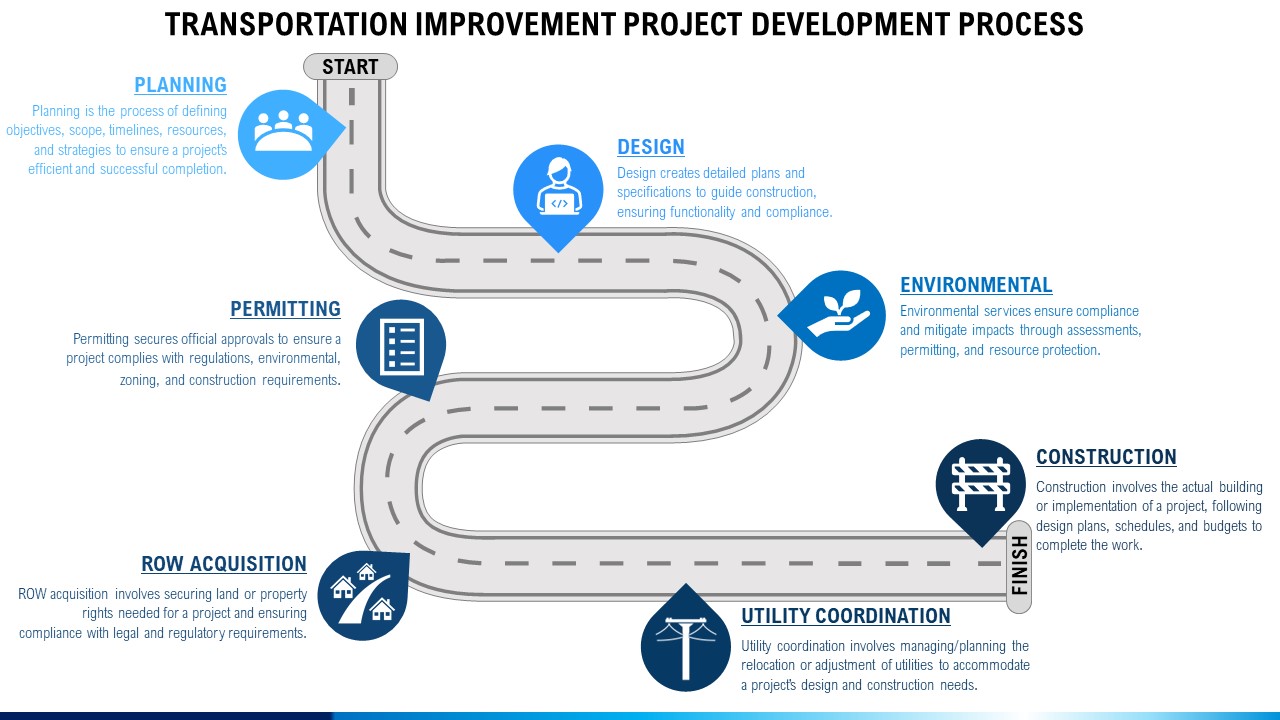
Planning Phase
The Planning Phase consists of defining the project’s scope, identifying potential challenges, and establishing the delivery approach. At this initial stage for significant projects, a scope of work and fee is developed, and a design firm is procured to provide the required professional services to develop the project. Developing and negotiating the scope of work and fee then obtaining County Council approval on the proposed design contract can take 3-5 months to obtain all required approvals and for a notice to proceed be issued for work to begin.
Additional Planning Phase Details
Key Components:
- Project Scope Identification: Determining the full extent of work needed and potential challenges
- Scope of Work Development: Creating detailed specifications for professional services required
- Design Firm Procurement: Selecting qualified professionals to design the project
- Contract Negotiation: Establishing fees, timelines, and deliverables
- County Council Approval: Obtaining necessary governmental approvals for design contracts
- Notice to Proceed: Official authorization for design work to begin on a project
Timeline Note: The planning phase approval process typically requires 3-5 months to obtain all required approvals and issue a notice to proceed. This phase is required before design can begin.
Design Phase
The Design Phase develops the detailed plans and approvals needed to advance a roadway project into construction. It begins with surveys, traffic studies, and environmental assessments, then progresses through preliminary, right-of-way, and final construction plans. Designers ensure compliance with local, state, and federal requirements, secure necessary permits, and coordinate with stakeholders to address concerns and minimize impacts. Cost estimates are prepared to align the project with available funding. The phase concludes with final design approval and construction quantity estimates, clearing the way for the Construction Phase.
Additional Design Phase Details
Key Components:
Initial Design:
Engineers conduct field surveys, traffic studies, and environmental assessments to determine the best approach for improving the roadway.
Engineers conduct field surveys, traffic studies, and environmental assessments to determine the best approach for improving the roadway.
Detailed Design:
This phase involves creating precise engineering plans, including roadway alignment, lane configurations, drainage systems, signage, and safety features.
This phase involves creating precise engineering plans, including roadway alignment, lane configurations, drainage systems, signage, and safety features.
- Preliminary Plans - This set of plans identifies the roadway alignment and lane configuration to determine the preliminary impacts of the project.
- Right-of-Way (ROW) Plans – The design from the preliminary plans is further refined and the detailed drainage design is finalized to determine any ROW acquisition needs. The ROW plans are what is used to start acquiring the necessary right-of-way for a project.
- Construction Plans – The design from the ROW plans is finalized including items such as pavement markings, signage, traffic signals, and traffic control. Once all design items are completed, quantities are estimated for all items needed to construct the project.
Permitting & Compliance:
Engineers ensure the project meets local, state, and federal regulations, obtain necessary permits and address environmental concerns.
Engineers ensure the project meets local, state, and federal regulations, obtain necessary permits and address environmental concerns.
- SC Department of Environmental Services (SCDES)
- SC Department of Environmental Services-Bureau of Coastal Management (SCDES-BCM)
- US Army Corps of Engineers (USACE)
- SC Department of Transportation (SCDOT)
- US Fish and Wildlife Service (USFWS)
- SC Historic Preservation Office (SHPO)
- National Oceanic and Atmospheric Administration (NOAA)
Stakeholder Coordination:
Authorities, businesses, and residents are engaged to gather feedback, mitigate disruptions, and improve project acceptance.
Authorities, businesses, and residents are engaged to gather feedback, mitigate disruptions, and improve project acceptance.
Cost Estimation & Budgeting:
Engineers prepare cost estimates to ensure the project aligns with financial constraints and funding sources.
Engineers prepare cost estimates to ensure the project aligns with financial constraints and funding sources.
Timeline Note: Depending on the type of project, the design phase can take typically take a year to several years to complete. A project cannot go to construction until this phase is complete.
Environmental Phase
The Environmental Phase ensures that a project identifies and addresses potential impacts on the human and natural environment through avoidance, minimization, and mitigation. Environmental assessments evaluate effects on air and water quality, wildlife, vegetation, and local communities, with public input helping to shape mitigation strategies. The project must comply with all applicable laws, including National Environmental Policy Act (NEPA) when federally funded, and secure necessary permits from regulatory agencies. Once mitigation plans are finalized and approvals obtained, the project receives final environmental clearance, allowing a project to advance to construction.
Additional Environmental Phase Details
Key Components:
Environmental Assessment:
Studies are conducted to evaluate potential impacts on air and water quality, wildlife, vegetation, and local communities.
Studies are conducted to evaluate potential impacts on air and water quality, wildlife, vegetation, and local communities.
Regulatory Compliance:
The project must meet federal, state, and local environmental laws, including the National Environmental Policy Act (NEPA).
The project must meet federal, state, and local environmental laws, including the National Environmental Policy Act (NEPA).
Public Involvement:
Stakeholders, including residents, businesses, and advocacy groups, provide input on environmental concerns and possible mitigation strategies.
Stakeholders, including residents, businesses, and advocacy groups, provide input on environmental concerns and possible mitigation strategies.
Mitigation Planning:
Strategies are developed to minimize environmental harm, such as erosion control, wildlife crossings, noise barriers, and pollution reduction measures.
Strategies are developed to minimize environmental harm, such as erosion control, wildlife crossings, noise barriers, and pollution reduction measures.
Final Environmental Clearance:
The project receives approval based on environmental impact studies and mitigation plans, allowing it to move into construction.
The project receives approval based on environmental impact studies and mitigation plans, allowing it to move into construction.
Timeline Note: Depending on the type of environmental document, the environmental phase can take typically take over a year to complete. A project cannot go to construction until final environmental clearance is obtained.
Permitting Phase
The Permitting Phase ensures that roadway projects comply with all applicable local, state, and federal regulations. Engineers coordinate with multiple agencies—including SCDES, SCDES-BCM, USACE, SCDOT, and Berkeley County to secure required permits. A project cannot move to construction until all permits are obtained.
Additional Permitting Phase Details
Key Components:
Stormwater Permitting:
Depending on the size of a project, a stormwater permit may be required through SC Department of Environmental Services (SCDES) and potential Berkeley County.
Depending on the size of a project, a stormwater permit may be required through SC Department of Environmental Services (SCDES) and potential Berkeley County.
Coastal Zone Consistency Certification:
All project will require a Coastal Zone Consistency Certification through SC Department of Environmental Services-Bureau of Coastal Management (SCDES-BCM)
All project will require a Coastal Zone Consistency Certification through SC Department of Environmental Services-Bureau of Coastal Management (SCDES-BCM)
Wetland Permits:
If a project impacts wetlands, a wetland permit will be required through US Army Corps of Engineers (USACE) and SCDES-BCM.
If a project impacts wetlands, a wetland permit will be required through US Army Corps of Engineers (USACE) and SCDES-BCM.
Encroachment Permits:
If a project is along a SC Department of Transportation (SCDOT) road or ties into a SCDOT roads, an encroachment permit will be required from SCDOT.
If a project is along a SC Department of Transportation (SCDOT) road or ties into a SCDOT roads, an encroachment permit will be required from SCDOT.
Timeline Note: Depending on the type of permits, the permitting phase can take typically take a few months to over a year. A project cannot go to construction until all permits are received.
Right of Way Acquisition Phase
The Right-of-Way (ROW) Acquisition Phase is the process in which all permissions and property interests necessary to construct a project are secured. These requirements are identified in the official ROW plans. During this phase, ROW agents work directly with property owners to obtain what is needed, with the goal of reaching voluntary agreements. If voluntary settlements cannot be reached, condemnation proceedings may be used. If federal funds are involved, all acquisitions must comply with the Uniform Relocation Assistance and Real Property Acquisition Policies Act of 1970 (Uniform Act) under the oversight of the Federal Highway Administration (FHWA). Relocation assistance is also provided to displaced individuals and businesses.
Additional Right of Way Acquisition Details
Key Components:
Right-of-way needs:
ROW plans are completed to determine if permissions or property is required. There are several types of ROW needs.
ROW plans are completed to determine if permissions or property is required. There are several types of ROW needs.
Title Searches:
A title search determines the legal owner of a property and identifies any liens, mortgages, or other encumbrances that affect ownership rights.
A title search determines the legal owner of a property and identifies any liens, mortgages, or other encumbrances that affect ownership rights.
Permissions:
When only a permission is needed, the ROW agent will attempt to secure it directly from the property owner. The property owner retains ownership, but the County is allowed to perform the specified work. If a permission cannot be secured, it may be converted into a formal ROW acquisition (“take”). There are numerous types of permissions but the most common are:
When only a permission is needed, the ROW agent will attempt to secure it directly from the property owner. The property owner retains ownership, but the County is allowed to perform the specified work. If a permission cannot be secured, it may be converted into a formal ROW acquisition (“take”). There are numerous types of permissions but the most common are:
Appraisals:
Independent evaluations to determine fair market value for the property to be acquired.
Independent evaluations to determine fair market value for the property to be acquired.
Written Offers:
ROW agents provide property owners with written purchase offers based on approved appraisals.
ROW agents provide property owners with written purchase offers based on approved appraisals.
ROW Acquisition:
ROW is obtained through one of two processes as described below.
ROW is obtained through one of two processes as described below.
Relocation Assistance:
If a project requires that people or businesses relocate, financial assistance is provided for moving expenses and replacement housing.
If a project requires that people or businesses relocate, financial assistance is provided for moving expenses and replacement housing.
ROW Certification:
The South Carolina Department of Transportation (SCDOT) may require ROW certification to confirm that all ROW acquisitions were completed in accordance with the Uniform Act, with FHWA oversight when federal funds are used.
The South Carolina Department of Transportation (SCDOT) may require ROW certification to confirm that all ROW acquisitions were completed in accordance with the Uniform Act, with FHWA oversight when federal funds are used.
Timeline Note: Depending on the amount of right-of-way that needs to be acquired, the ROW phase may last anywhere from a few months to several years to complete. A project cannot go to construction until all the right-of-way is obtained.
Utility Coordination Phase
The Utility Coordination Phase ensures that existing utilities are identified, conflicts with roadway improvements, and necessary relocations are managed to avoid project delays. Early in project planning, utility owners are notified, and existing facilities are mapped through records research and field verification. During design, conflicts with proposed roadway improvements are analyzed, and relocation responsibilities and cost allocations are determined. Final design includes detailed utility work plans aligned with the project schedule and ROW requirements. Agreements and permits are executed as needed. During construction, coordination meetings ensure proper sequencing, safety, and progress tracking. After construction, as-built records are updated, utilities are verified, and agreements are closed out.
Additional Utility Coordination Details
Key Components:
ROW Certification:
The South Carolina Department of Transportation (SCDOT) may require ROW certification to confirm that all ROW acquisitions were completed in accordance with the Uniform Act, with FHWA oversight when federal funds are used.
The South Carolina Department of Transportation (SCDOT) may require ROW certification to confirm that all ROW acquisitions were completed in accordance with the Uniform Act, with FHWA oversight when federal funds are used.
Initial Utility Identification:
The Project Team informs local utility owners of the project and gathers information on their existing utility infrastructure within the project limits.
The Project Team informs local utility owners of the project and gathers information on their existing utility infrastructure within the project limits.
Records Research and Field Investigations:
To help determine the location of the existing utilities in a project area, the Project Team performs utility locates by using 811 locates, ground-penetrating radar, potholing, or subsurface utility engineering (SUE) as needed to verify location and depth
To help determine the location of the existing utilities in a project area, the Project Team performs utility locates by using 811 locates, ground-penetrating radar, potholing, or subsurface utility engineering (SUE) as needed to verify location and depth
Conflict Analysis:
Project team compares utility locations with preliminary roadway plans and identifies conflicts with the proposed construction.
Project team compares utility locations with preliminary roadway plans and identifies conflicts with the proposed construction.
Preliminary Utility Coordination Meeting:
The Project Team meets with the utility companies to share project plans and begin discussions about relocations, design accommodations, or potential adjustments.
The Project Team meets with the utility companies to share project plans and begin discussions about relocations, design accommodations, or potential adjustments.
Determine Responsibility:
The Project Team assess whether utility relocations are at the expense of the utility owner or the project sponsor, based on state law, permits, and agreements.
The Project Team assess whether utility relocations are at the expense of the utility owner or the project sponsor, based on state law, permits, and agreements.
Utility Work Plans:
The utility owners submit relocation plans and schedules for any necessary adjustments. These work plans are coordinated with the construction phasing and overall project schedule.
The utility owners submit relocation plans and schedules for any necessary adjustments. These work plans are coordinated with the construction phasing and overall project schedule.
Utility Agreements & Permitting:
The Project Team develops agreements for any utility relocation and ensures the utility companies have all necessary permits.
The Project Team develops agreements for any utility relocation and ensures the utility companies have all necessary permits.
Utility Relocation:
The utility companies have their utilities relocated as necessary. The Project Team meets with utility companies on a regular based to monitor utility relocation progress to ensure alignment with project timeline.
The utility companies have their utilities relocated as necessary. The Project Team meets with utility companies on a regular based to monitor utility relocation progress to ensure alignment with project timeline.
Utility Window:
If there are significant utility relocations, a utility window is added to a project. The contractor will prepare the site for the utility companies to relocate their utilities. During this time, the contractor may not have access to the project site.
If there are significant utility relocations, a utility window is added to a project. The contractor will prepare the site for the utility companies to relocate their utilities. During this time, the contractor may not have access to the project site.
Timeline Note: Utility coordination takes place through the design process of a project. A project cannot go to construction until the utility coordination is completed.
Construction Phase
The Construction Phase transforms project plans into a completed roadway. Following contract award and a pre-construction conference, a Notice to Proceed (NTP) initiates site mobilization, traffic control, and erosion protections. Major construction activities include demolition, earthwork, drainage and utility installations, paving, and construction of structures, curbs, sidewalks, and signals. Throughout the process, quality control testing, inspections, and environmental and safety compliance are maintained. As the project nears completion, a punch list is addressed, final inspections are performed, and substantial acceptance is granted. The phase concludes with updated as-built drawings, final payment processing, and formal project close-out, ensuring all contractual, environmental, and regulatory obligations are met.
Additional Construction Phase Details
Pre-Construction Activites:
Award and Contract Execution:
After bidding, the contract is awarded to the lowest responsive and responsible bidder. A construction contract is executed, including all specifications, drawings, and special provisions
After bidding, the contract is awarded to the lowest responsive and responsible bidder. A construction contract is executed, including all specifications, drawings, and special provisions
Pre-Construction Conference:
This meeting is held with the contractor, project owner (e.g., Berkeley County), consultant/engineer, utilities, and other stakeholders. The project scope, schedule, safety, permits, utility coordination, environmental compliance, and communication protocols are discussed during this meeting.
This meeting is held with the contractor, project owner (e.g., Berkeley County), consultant/engineer, utilities, and other stakeholders. The project scope, schedule, safety, permits, utility coordination, environmental compliance, and communication protocols are discussed during this meeting.
Notice to Proceed (NTP):
This is the official start date for construction. The project’s construction duration and milestones are tracked from this point.
This is the official start date for construction. The project’s construction duration and milestones are tracked from this point.
Mobilization and Site Preparation:
Contractor Mobilization:
This is when equipment, materials, and personnel are brought to the site and temporary facilities (e.g., staging areas, field offices) are established.
This is when equipment, materials, and personnel are brought to the site and temporary facilities (e.g., staging areas, field offices) are established.
Traffic Control and Safety:
Temporary traffic control (per MUTCD) is implemented to maintain traffic flow and protect workers and the public. Detours, signs, and flaggers are established as needed throughout the construction of the project.
Temporary traffic control (per MUTCD) is implemented to maintain traffic flow and protect workers and the public. Detours, signs, and flaggers are established as needed throughout the construction of the project.
Erosion and Sediment Control:
Environmental protections (e.g., silt fences, stormwater basins) are installed per the Stormwater Pollution Prevention Plan (SWPPP)
Environmental protections (e.g., silt fences, stormwater basins) are installed per the Stormwater Pollution Prevention Plan (SWPPP)
Major Construction Activities:
Demolition and Clearing
This includes clearing and grubbing within the project limits and the removal of existing pavement, structures, or vegetation.
This includes clearing and grubbing within the project limits and the removal of existing pavement, structures, or vegetation.
Utility Relocation
The utility companies have their utilities relocated as necessary. The Project Team meets with utility companies on a regular based to monitor utility relocation progress to ensure alignment with project timeline.
The utility companies have their utilities relocated as necessary. The Project Team meets with utility companies on a regular based to monitor utility relocation progress to ensure alignment with project timeline.
Utility Window
If there are significant utility relocations, a utility window is added to a project. The contractor will prepare the site for the utility companies to relocate their utilities. During this time, the contractor may not have access to the project site.
If there are significant utility relocations, a utility window is added to a project. The contractor will prepare the site for the utility companies to relocate their utilities. During this time, the contractor may not have access to the project site.
Earthwork and Grading
This includes excavation, embankment construction, and subgrade preparation to ensure proper drainage and foundation stability.
This includes excavation, embankment construction, and subgrade preparation to ensure proper drainage and foundation stability.
Drainage Installation
This includes the installation of culverts, storm drains, and underdrains.
This includes the installation of culverts, storm drains, and underdrains.
Pavement Construction
This includes the placement of base layers, asphalt, or concrete pavement.
This includes the placement of base layers, asphalt, or concrete pavement.
Structures (if applicable)
This includes the construction of bridges, retaining walls, sound barriers, and culverts constructed or rehabilitated.
This includes the construction of bridges, retaining walls, sound barriers, and culverts constructed or rehabilitated.
Curb, Gutter, Sidewalks, and Signals
This includes the construction of pedestrian elements and traffic control devices.
This includes the construction of pedestrian elements and traffic control devices.
Quality Control and Assurance:
Materials Testing
This includes regular sampling and testing of materials (asphalt, concrete, soils) for compliance with specifications.
This includes regular sampling and testing of materials (asphalt, concrete, soils) for compliance with specifications.
Inspections
This includes daily construction inspections and formal milestone inspections.
This includes daily construction inspections and formal milestone inspections.
Environmental and Safety Compliance:
Environmental Monitoring
This includes inspections to ensure compliance with NEPA commitments, permits (e.g., NPDES), and erosion control plans.
This includes inspections to ensure compliance with NEPA commitments, permits (e.g., NPDES), and erosion control plans.
Worker and Public Safety
This includes ongoing enforcement of OSHA standards and project-specific safety protocols.
This includes ongoing enforcement of OSHA standards and project-specific safety protocols.
Substantial Completion and Closeout:
Punch List
This is a list of outstanding items is created near project end (e.g., striping, signage, landscaping).
This is a list of outstanding items is created near project end (e.g., striping, signage, landscaping).
Project Acceptance
This is when all the punch list items are complete and the warranties and maintenance responsibilities may shift to the owner
This is when all the punch list items are complete and the warranties and maintenance responsibilities may shift to the owner
As-Built Drawings
These are an updated set of plans that reflect actual construction conditions and deviations from design.
These are an updated set of plans that reflect actual construction conditions and deviations from design.
Final Quantities
This is the final measurement of work completed, resolution of any disputes or claims, and processing of final payment and release of retainage.
This is the final measurement of work completed, resolution of any disputes or claims, and processing of final payment and release of retainage.
Project Close-Out
This is submission of all required reports, certifications, and documentation.
This is submission of all required reports, certifications, and documentation.
Timeline Note: Depending on the size of the project, the construction phase can take typically take a few months to several years to complete.
